
Software Development for Virtual Concierge and Information Kiosk for Rehabilitation Centers

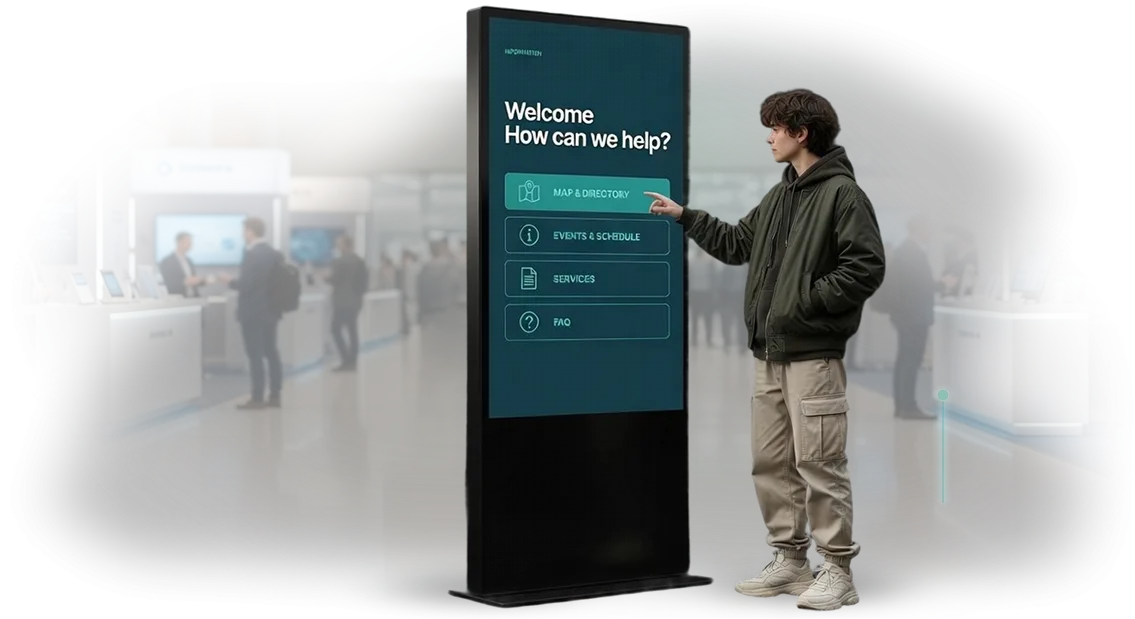
An interactive kiosk helps visitors of a rehabilitation center quickly find offices, sign up for procedures, and get answers without the administrator's involvement. We will develop a user-friendly interface with large buttons, clear navigation, and a virtual concierge that answers common queries. This reduces staff workload and makes the stay at the center more comfortable.
Showing 1 of 1All 536 services
Software Development for Virtual Concierge and Information Kiosk for Rehabilitation Centers
Medium
from 2 weeks to 1 month

What interactive kiosk development includes

Other studio services

Frequently Asked Questions

העבודות האחרונות

  • image_interactive-kiosks_mir_castle_interactive_kiosk_623_0.webp
    Interactive time-travel experience for Mir Castle
    156
  • image_interactive-kiosks_helix_industry_branded_kiosk_624_0.webp
    Helix Industry · Branded info-kiosk
    141
  • image_interactive-kiosks_grain_silos_interactive_stand_625_0.webp
    Grain silos
    161
  • image_interactive-kiosks_industrial_pumps_kiosk_626_0.webp
    Industrial pumps
    128
  • image_interactive-kiosks_water_treatment_systems_kiosk_627_0.webp
    Water treatment systems
    147

Poor navigation — a key problem for rehabilitation centers

Visitors to rehabilitation centers arrive under stress and anxiety — they need to quickly understand where to go and feel cared for from the moment they walk in.

When clinic navigation is limited to paper signs and lines at the reception desk, people lose trust in the facility even if the doctors do excellent work. Any routing failure — lost minutes, confusion, and negativity — takes a toll on the center's reputation.

The absence of a modern information kiosk overloads staff: administrators answer the same questions hundreds of times, distracted from handling inquiries and paperwork. While an employee shows a confused visitor the way, others wait, and tension grows in the reception area. This hurts both service quality and the team's emotional state — along with patient loyalty.

A virtual concierge solves this problem systematically. An information kiosk helps visitors independently find the right office, check a specialist's schedule, get clear directions around the building, and answers to common questions — without an administrator's involvement.

Clinic navigation becomes intuitive, and people feel supported at all times, even when no staff member is nearby.

For a center's leadership, this means reduced staff workload and a more predictable flow of inquiries. Instead of the routine "where do I go?", administrators focus on truly important tasks, and patients get a positive experience from the very first touchpoint.

We design and implement such kiosks for each facility's specific needs, provide post-launch support, and help reconfigure scenarios when services or layouts change. This addresses the main pain point — visitor trust and a calm, efficient team.

What will change when the center gets an interactive kiosk

Visitors to a rehabilitation center come for care and attention, not technology. When someone needs to quickly find an office, check a procedure schedule, or call for help, they don't want to stand in line and figure out who to ask.

An interactive kiosk handles these questions — the guest gets an answer in seconds, and administrators stop getting distracted by repetitive inquiries and focus on what really matters.

For the center, this means three key changes: higher visitor satisfaction, shorter lines, less staff strain, and stronger loyalty from both guests and their families, who often make the decision about returning.

Fewer queues and lighter workload for administrators

Every repetitive question — "where is the office?", "when does the procedure start?" — takes minutes of an administrator's time and makes visitors wait.

The kiosk automatically answers common requests: it shows directions, schedules, specialist contacts, and residency rules. The administrator handles only non-standard situations — and the queue moves faster even during peak hours.

Greater loyalty and higher satisfaction

Someone arriving for rehabilitation is often anxious and disoriented. When they can find their way on their own, they feel more confident and at ease. And a calm, grateful guest is more likely to recommend the center to others and return for follow-up programs.

The kiosk works around the clock and never gets tired: in the evening, when fewer staff are on hand, visitors still get the information they need.

Automated information services — protecting reputation

The kiosk doesn't just show information — it also helps with paperwork: it reminds visitors of required documents, suggests step-by-step actions for check-in, and displays forms to fill out.

This reduces errors, speeds up registration, and creates the impression of a well-run, caring facility. Staff deal with less routine work, visitors experience less stress, and leadership gains time for development instead of putting out fires.

We build these kiosks on professional equipment and reliable software, so performance is stable from day one. The center gets a ready-made tool that starts working for its reputation and loyalty immediately after installation.

Kiosk formats for rehabilitation centers: comparison and selection

Patients and visitors to a rehabilitation center often find themselves in unfamiliar surroundings: stress, confusion, questions for staff. Interactive kiosks relieve this pressure — they answer common requests without queues, show routes, and introduce procedure schedules. But different tasks require different formats.

To choose wisely, you don't need to be a tech expert. It's enough to understand what action a person needs to take: get information, find an office, or book an appointment with a specialist. Below is a comparison of the three main formats we implement in rehabilitation centers.

Format Who it's for What it gives the client
Information kiosk Patients looking for information about schedules, doctors, and services Reduces the load on reception; the patient gets an answer in a couple of minutes without waiting in line
Virtual concierge Visitors and companions who need a guided scenario Personal prompts: when, where, and to whom to go. Helps avoid missing procedures and reduces anxiety
Interactive map Patients and guests navigating buildings and floors Eliminates time lost searching for an office; makes moving around the center calm and predictable

How the format affects the experience

An information kiosk eliminates the daily "hundred identical questions" at the administrator's desk: freed-up staff focus on patients instead of searching for schedules.

The virtual concierge adds a personalized scenario — it visually mirrors the doctor's recommendations so the person knows exactly their next step.

An interactive map is useful on every floor and in the lobby: it shows the route to a treatment room, the cafeteria, or the exit. Together, these formats form a unified wayfinding system that acts like a caring assistant — no phone calls, no queues, no unnecessary inquiries.

What we consider when choosing

At the briefing stage, we look at the center's floor area, visitor flows, and typical patient scenarios. For small departments, one information kiosk is enough; for a multi-building center, all three formats with shared navigation logic are optimal.

We've already implemented similar projects for medical facilities: the system ran without failure and handled up to 40% of routine inquiries. The technical foundation is professional touch panels and reliable software with remote administration. So the client gets a stable result without needing a developer on site.

Choosing the right format isn't about technology — it's about the center's goals: speeding up service, reducing patient anxiety, or easing staff workload. We'll help you select a configuration for your budget and launch the kiosk turnkey.

How the interactive kiosk development process works: stages and timeline

An interactive kiosk in a rehabilitation center is more than an information device — it's a tool that relieves administrators and helps patients quickly find their way through departments and services.

So you don't have to worry about progress, we've made the development process step-by-step and transparent. At our team, every stage is coordinated with you, and all decisions are made before the next step begins.

  1. Briefing and needs assessment. We discuss the kiosk's goals: what questions it should handle and who will use it — patients, visitors, or staff. We finalize the feature list and agree on it to avoid building anything unnecessary.

  2. Plan, timeline, and estimate. Based on the brief, we propose the section structure, design concept, and work schedule. You see the implementation timeline and understand the scope before we start, so there are no surprises or extra costs later.

  3. Wireframes and navigation logic. We prepare a screen prototype: main menu, search, building map. As the client, you see how the kiosk will look and can make changes while it's still on paper — that's faster and cheaper than reworking the finished product.

  4. Development and content. We program the kiosk logic and load information about the center, schedules, and services. We work on professional equipment so the kiosk runs reliably during peak hours and doesn't freeze under heavy visitor traffic.

  5. Testing and staff training. We test every scenario — from a typical patient question to administrator actions for updating information. We provide brief staff training and a clear instruction manual.

  6. Launch, warranty, and support. We install the kiosk on site and configure it for your specific space. We offer a warranty and stay in touch: we quickly update data, add sections, and refine features as the center grows.

This approach is clear and predictable: you always know where the project stands, when the kiosk will be ready, and exactly what you'll get in the end.

What's included in delivery: the complete package for your center

When you order an interactive kiosk for a rehabilitation center, it's important to understand exactly what you're getting — not just a device but a complete solution that starts working immediately.

We've assembled a full package: from software setup to staff training and ongoing technical support. All you have to do is plug the kiosk in — everything else is ready.

  • Software with a virtual concierge — all information about the center, procedure schedules, doctor lists, and building navigation are loaded and configured for your specific needs.
  • Easy-to-use interface with large buttons — the screen is designed for people of different ages and health conditions: large type, simple icons, and minimal steps to get an answer.
  • Staff guide and quick-reference cards — step-by-step instructions for updating schedules, changing contacts, or adding important announcements. Any administrator can handle it without technical skills.
  • Staff training — we conduct a session online or in person: we show how to use the system on a real kiosk, answer questions, and leave a recording of the lesson for new staff.
  • Warranty service for the full term of the contract — remote diagnostics, regular software updates, and priority support by phone and chat. If something goes wrong, we resolve it quickly.
  • Launch assistance — on the kiosk's first day of operation, our specialist connects remotely, checks the settings, and confirms with your administrator that everything is working correctly.
  • Customization options for your center — add building maps, exercise videos, individual patient plans, or any other sections you need.

This package relieves staff of basic visitor questions and frees up time for work with patients. Warranty service provides confidence: the kiosk will work in a month and in a year, and if any issues arise, you won't be left alone with the hardware. All we need from you is up-to-date information about the center — we take care of the rest.

Case study: how a kiosk reduced the workload on administrators

Before implementation, administrators at a rehabilitation center spent up to a third of their workday on repetitive questions: procedure schedules, office locations, visiting rules.

Patients and their families came back to the front desk again and again, and staff had no time left for truly important tasks. We proposed covering the flow of routine inquiries with an interactive kiosk that works as a virtual concierge.

The center where we carried out the implementation is a facility with 120 patients, round-the-clock care, and a steady flow of visitors. The kiosk was installed in the lobby, next to the waiting area.

Within two weeks, administrators noted that they were distracted less often from paperwork and phone calls. The system took over routing and information services, and staff got a dashboard with analytics on the most frequent requests.

Key results in the first months of operation: administrator workload dropped by 37%, and the average response time for a typical question fell from three minutes to twenty seconds.

61% of inquiries about schedules, buildings, and rules are resolved by visitors on their own — without staff involvement. For the center, that means saving roughly 25 working hours a month on information services alone.

Director's feedback: "Previously, in peak hours a queue formed at the front desk, and people got anxious even before their procedures started. Now a guest walks up to the terminal, gets the information they need in half a minute, and calmly follows the suggested route.

Staff stopped working as ushers and focused on their actual duties. After two months, we realized we never want to go back."

For us, this confirms a simple rule: the kiosk is not a replacement for human interaction — it's a tool that reduces routine and makes service faster. Patients get help instantly, administrators have less stress and more time for people who truly need their attention. We can adapt the same approach to your center's needs.

How to choose the right format for your center's needs?

Choosing a kiosk configuration for a rehabilitation center does raise questions: you want maximum value without overpaying or dealing with operational inconveniences. In practice, the decision comes down to three parameters: floor space, average visitor flow, and planned budget.

If you assess these in advance, you can choose a format that works for patient comfort and the center's image rather than just taking up space.

For small lobbies and compact waiting areas, wall-mounted units are optimal — they don't block walkways and are clearly visible from a distance.

If the center has a spacious reception area or a high-traffic corridor, a floor-standing kiosk becomes a prominent navigation and information hub. A larger screen lets you display more reference information and makes interaction easier for older patients who need readable fonts.

Visitor flow affects reliability and performance requirements.

In facilities where dozens of people use the kiosk daily, a standard build is sufficient, but with heavy appointment scheduling and a constant stream of questions, it's worth choosing a configuration with a reinforced enclosure and fault-tolerant system.

This reduces downtime risk and keeps administrators from having to replace equipment in the middle of a busy day.

Budget determines the configuration: the basic version covers the key tasks — schedules, navigation, reference information; the extended version adds integration with specialist booking, feedback collection, and the ability to update content without hiring a contractor.

What matters isn't the price itself but the service life and total cost of ownership: a properly selected configuration pays for itself through reduced staff workload and higher patient satisfaction.

We select a configuration based on your center's specific tasks and always propose options that fit the budget without compromising quality.

Just tell us your floor area, approximate visitor flow, and desired functionality — within a few days, you'll receive a ready-made solution with a cost calculated after audit and placement recommendations.

Frequently asked questions about how interactive kiosks work

The main concerns when introducing an interactive kiosk in a rehabilitation center usually relate not to functionality but to reliability: "What if it breaks? Who will update the schedules?

Will we have to hire new staff?" We'll answer these questions directly — they concern the kiosk's day-to-day operation, not technical details.

What happens if the equipment fails?

We take full responsibility for kiosk maintenance. The contract specifies response times — we'll send someone within 24 hours if needed. While repairs are being made, we provide replacement equipment, so visitors won't notice any interruption. Scheduled preventive maintenance is carried out without stopping center operations.

How do we update content: schedules, news, doctor lists?

You don't need a programmer. Updates are made through a simple admin panel — it's similar to editing a social media page. Changes appear on the screen instantly.

If there's no one to handle it, we take over remote management: you send us a file with the latest data, and we post it within one business day.

Will we need to replace or train staff?

No. The kiosk handles routine inquiries: building navigation, procedure schedules, patient guides. Administrators are freed up for personal interaction and non-standard situations. Staff training takes no more than an hour, and after launch we're always available by phone.

How well does the kiosk handle heavy daily use?

We use professional industrial equipment designed for continuous operation from morning to evening. The enclosure is protected against accidental bumps and scratches, and the screen withstands frequent touch.

A built-in power supply protects against voltage spikes — the kiosk runs reliably even in older buildings.

These answers usually address the main concerns. If you have more questions, just ask: we'll explain how a kiosk would fit into your center's processes and arrange a demonstration with your data.

What you get after reaching out: plan, estimate, and timeline

Submit a request and you'll receive not just promises but a working document package up front: plan, estimate, and timeline. We know how much certainty matters for rehabilitation centers when every day counts, so we get straight to specifics.

What's included in the project estimate:

  • A brief with clarifying questions — to define the kiosk's objectives: booking with a specialist, building navigation, reference information.
  • A step-by-step implementation plan: from menu structure to testing and launch. You can see what happens and when.
  • An estimate broken down by work and equipment — no hidden items; you understand what you're paying for and how the final figure is built.
  • A calendar schedule with completion dates for each stage and a note on how it depends on your feedback — you know in advance when the kiosk will go live.
  • A list of the team and those responsible: who prepares content, who programs, who provides post-launch support.
  • Recommendations for integration with your existing client booking system, if you have one, so the kiosk becomes part of your processes.

Once the commercial proposal is approved, you get a contract with a fixed price and warranty obligations. This way you avoid double approvals and mid-project surprises — you just track progress and prepare content with us.

The package is usually ready within two to three days; submitting a request doesn't obligate you to anything — you decide only after seeing the plan and estimate.